PowerPool Concentrated Voting Power (CVP) is the native governance token of the PowerPool protocol. Holders of the CVP token can participate and vote on changes to PowerPool’s smart contract and operational parameters, in addition to voting collectively in other Ethereum-based protocols.
PowerPool is a decentralized finance (DeFi) protocol that seeks to address two critical issues which currently affect many on-chain governance systems: i) majority stakeholder (whale) dominance and ii) governance token cashflow.
The first issue stems from the fact that most platforms have a small number of whales who, by virtue of their holding size, often de-facto run a platform. Minority stakeholders who are disparate and have few governance tokens in their possession thus have little power in influencing or swaying a proposal. This often results in voter apathy, with many governance tokens left either underutilized or unused entirely.
The second issue is cashflow, which most governance tokens do not provide. Governance token holders can only enjoy the monetary benefits of their holdings if they divest them or participate in incentive programs, which are often transient. When combined, these two issues arguably result in a scenario where the utility of governance tokens for minority shareholders are close to zero.
By enabling holders of governance tokens to pool, borrow, lend, gain income, and accumulate governance power from their holdings, PowerPool expands the utility of governance tokens for the end-user and provides a platform for better decision-making and coordination within the DeFi space.
More about PowerPool and the idea behind its inception can be found in the protocol’s GitHub introduction.
The CVP token has two core functions: i) governance and ii) meta-governance.
Similar to individuals who hold other governance tokens such as Maker, CVP token holders can submit and vote on changes to the PowerPool protocol. For instance, modifying or adding new functionality in PowerPool’s smart contract, proposing new indices, changing the composition of existing indices etc.
Meta-governance meanwhile, is a function that allows CVP holders to collectively vote in an underlying Ethereum-based protocol such as Compound, Yearn Finance or Uniswap. In a Compound token pool for instance, if 10,000 COMP are supplied and 7,000 are borrowed, then CVP holders can vote to decide how to use the remaining 3,000 unclaimed COMP when a proposal is put forward in Compound.
In practice, governance and meta-governance proposals are first discussed among community members before votes are cast. A proposal is only considered valid when a quorum of at least 400,000 CVP is met. All active, executed or defeated proposals can be viewed on PowerPool’s app, Boardroom or forum.
Additionally, CVP holders are able to earn rewards by adding CVP liquidity to either of PowerPool’s indices or staking their CVP holdings to create price reporters/oracles. More details on CVP’s value proposition can be found in PowerPool’s Medium post.
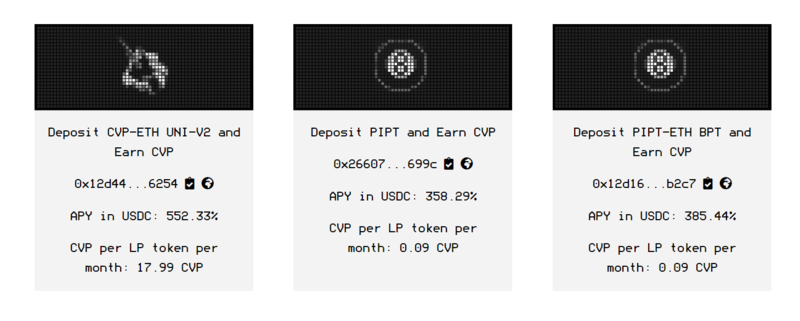
Presently, there are two main ways to obtain CVP tokens: i) purchasing it from an exchange and ii) liquidity mining. Obtaining CVP from a cryptocurrency exchange such as Binance or Uniswap is the more straightforward of the two methods. The various centralized and decentralized cryptocurrency exchanges can be browsed via the link provided.
To get CVP through liquidity mining, users should head to PowerPool’s mining page to view which tokens can be provided to earn CVP. For instance, Power Index Pool Token (PIPT) can be deposited to earn a set amount of CVP per PIPT per month.
In order to get PIPT however, users must first add liquidity to the PowerIndex pool by depositing any of the governance token which PowerIndex consists of. If a user has no governance token holdings however, PIPT can also be obtained via Uniswap in exchange for another crypto asset such as Ethereum.